
Bangalore didn’t just become India’s IT capital by accident and now it’s the WFH capital too. With hybrid work firmly settled into the city’s rhythm, thousands of professionals across Whitefield, Indiranagar, HSR Layout, Sarjapur Road, and Koramangala are asking the same question: how do you carve out a real home office inside a standard 2BHK apartment?
The honest answer is you don’t need a spare room. You need smart design. This guide walks you through practical, Bangalore-specific ways to build a productive, comfortable, and good-looking home office without sacrificing your living space.
What Exactly Is a “Home Office” in a 2BHK Context?
A home office, in the way it’s being designed today, isn’t necessarily a separate room. In a 2BHK where every square foot is already accounted for between bedrooms, living, dining, and kitchen a home office is best understood as a dedicated, purpose-built work zone integrated into existing spaces.
This could be:
- A desk and shelving unit built into a bedroom corner
- A converted balcony with weatherproofing and a slim work table
- A study nook carved out of the living or dining area using partitions or furniture placement
- A fold-away or wall-mounted desk that disappears when not in use
The defining feature isn’t square footage it’s intent. A home office is designed with proper lighting, ergonomic furniture, cable management, and acoustic consideration, as opposed to simply placing a laptop on the dining table.
It also helps to think of a home office less as a single room and more as a system of small decisions where you sit, what you see behind you on a call, how quickly you can “close” the workspace at the end of the day, and how well it blends into the rest of the home when you’re not using it. In a 2BHK, a home office that can visually disappear after work hours a desk that tucks away, a chair pushed in, a screen folded flat tends to work far better in practice than one that permanently occupies the room’s identity.
Why Is This Trending So Strongly in Bangalore Specifically?
A few city-specific factors are driving this in a way that’s more pronounced in Bangalore than in many other Indian metros.
1. Bangalore’s IT and Tech-Driven Workforce
As India’s largest tech hub, Bangalore has one of the highest concentrations of professionals working in hybrid or fully remote arrangements. For this workforce, a functional home workspace isn’t optional it’s a daily necessity.
2. Hybrid Work Has Outlasted the Pandemic
What started as a temporary pandemic-era adjustment has settled into a long-term hybrid work culture across Bangalore’s IT corridors Whitefield, Outer Ring Road, Electronic City, and Sarjapur Road in particular. Companies offering 2–3 days of WFH per week means employees need a workspace that’s usable regularly, not occasionally.
3. Rising Apartment Costs Are Shrinking Available Space
As real estate prices in Bangalore continue to climb, more households are optimizing 2BHK layouts instead of upgrading to 3BHKs purely for a spare room. This has pushed homeowners and designers to get creative with multi-functional spaces rather than relying on extra square footage.
4. A Cultural Shift Toward Intentional Interior Design
Bangalore’s interior design market has matured significantly. Homeowners today are far more likely to consult a professional designer for space planning than they were five years ago, and home offices have become one of the most commonly requested additions in consultation briefs.
5. Video-Call Culture Has Changed Design Priorities
With virtual meetings now a daily part of work life, homeowners increasingly care about how their background looks on camera driving demand for clean, well-lit, aesthetically considered work corners rather than a cluttered desk shoved into a hallway.
6. Bangalore’s Weather Makes More of the Home “Usable” Year-Round
Compared to cities with extreme summers or heavy year-round humidity, Bangalore’s relatively moderate climate means spaces like balconies and semi-open corners stay comfortable enough to work in for most of the year. This has made previously overlooked areas of the home genuinely viable as workspaces, which isn’t as easy to pull off in other Indian metros.
7. Rental and Resale Value Considerations
Real estate agents and property consultants across Bangalore are increasingly noting that a well-designed home office adds tangible appeal for both renters and resale buyers, particularly among the city’s large tenant base of tech and startup employees. A functional work corner is quietly becoming a differentiator in listings, much like a modular kitchen or a balcony view once was.
How the Trend Is Showing Up in Real Bangalore Homes
Designers across the city are seeing a few consistent patterns:
- Second bedrooms doing double duty guest room by night, functional office by day, using Murphy desks or foldable furniture
- Balconies being reclaimed as workspaces, especially in apartments with good natural light and manageable monsoon exposure
- Living rooms getting “zoned” open shelving or slim partitions creating a visual (not structural) separation between work and living areas
- Built-in carpentry over loose furniture homeowners increasingly prefer custom-built desks and shelving that fit exact wall dimensions, rather than off-the-shelf furniture that eats up more space than necessary
Who’s Actually Driving This Demand?
Designers report that requests for home offices in Bangalore are coming from a fairly wide cross-section of homeowners, not just one demographic:
- Young dual-income couples in areas like HSR Layout and Koramangala, both working hybrid tech jobs, often need two functional work zones in a single 2BHK
- First-time homebuyers who are factoring in a home office at the design brief stage itself, rather than treating it as an afterthought
- Freelancers and consultants, a growing segment in Bangalore, who need a workspace that supports client calls and long, focused work sessions
- Landlords and property owners upgrading rental units to attract Bangalore’s large working-professional tenant pool, for whom a ready-made work corner is a genuine rental advantage
How to Design a Home Office That Actually Works
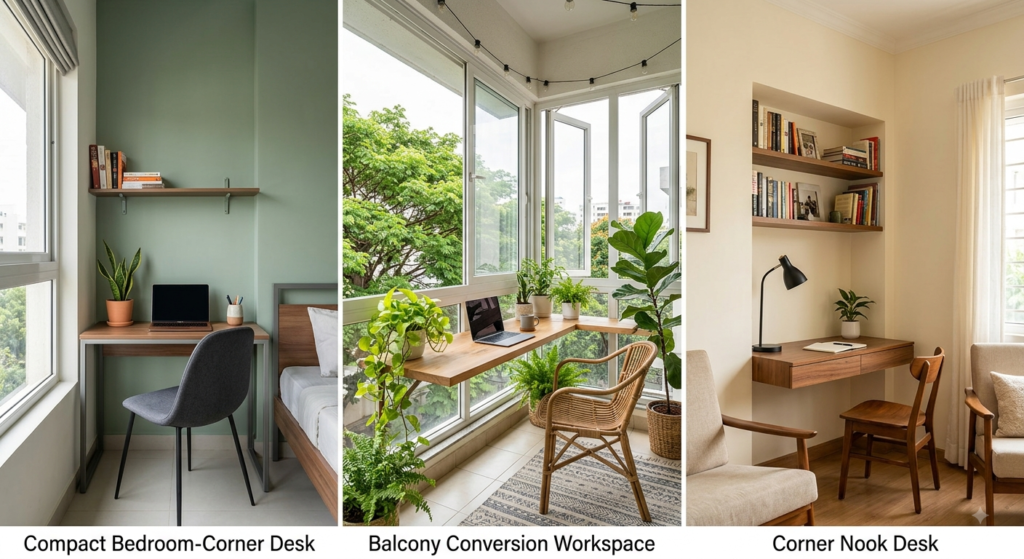
If you’re considering this for your own 2BHK, here’s a practical starting framework:
1. Identify your best available zone. Look for a spot with access to natural light and proximity to power points a balcony, an alcove, or an underused bedroom corner are usually the strongest candidates.
2. Prioritize multi-functional furniture. Foldable desks, wall-mounted work surfaces, and vertical shelving keep the footprint minimal without compromising usability.
3. Get lighting layered right. Combine ambient lighting with focused task lighting to avoid eye strain during long work hours this matters more than most homeowners initially expect.
4. Plan for acoustics. Soft furnishings, rugs, and fabric dividers help absorb sound in open-plan apartments, especially important for video calls.
5. Don’t ignore aesthetics. A home office should feel like a considered part of your home, not an improvised leftover corner a good backdrop, plants, and a cohesive color palette go a long way.
6. Work with a local designer for tricky layouts. Apartment societies in Bangalore often have specific rules around structural changes, so a designer familiar with local building norms can save you time and avoid compliance issues.
7. Plan power and connectivity early. Before committing to a desk location, check how many power points are nearby and whether your Wi-Fi router placement gives you a stable signal retrofitting extra sockets or extension boards later is far more disruptive than planning for it upfront.
8. Choose materials suited to Bangalore’s climate. Engineered wood and laminate finishes tend to hold up better than solid wood against seasonal humidity shifts, especially if your work zone is near a balcony or window.
9. Keep future flexibility in mind. Since hybrid work arrangements can change, it helps to design a work zone that can be repurposed a desk that could later become a vanity unit, or a nook that could revert to storage rather than a highly specialized setup that only works as an office.
Why Bangalore’s 2BHK Homes Need a Different WFH Approach
Most 2BHK apartments in Bangalore fall between 900–1200 sq. ft., and the second bedroom is usually already earmarked as a guest room, kids’ room, or storage overflow. Unlike Western home office guides that assume a spare study, Bangalore homeowners are working with:
- Compact room sizes compared to global WFH content that assumes larger homes
- Multi-purpose rooms that need to function as bedroom + office + storage simultaneously
- Open-plan living/dining areas that are often the only flexible space available
- High-rise apartment restrictions on structural changes, since most buildings don’t allow you to break walls or alter electrical layouts significantly
- Humidity and monsoon dampness, which affects material and furniture choices more than in drier cities
This means your home office strategy has to be layout-driven, not renovation-driven. Here’s how to do it right.
Step 1: Choose the Right Spot Before You Choose Furniture
Before buying a single chair, walk through your apartment and evaluate these zones:
Option A: The Underused Corner of the Second Bedroom
If your second bedroom already serves as a guest/kids’ room, you can still slot in a compact desk along one wall. A corner desk uses minimal footprint while keeping the rest of the room fully functional.
Option B: The Balcony Conversion
Bangalore’s pleasant year-round climate (barring peak monsoon) makes balconies a genuinely usable option. A glazed or semi-enclosed balcony with a slim desk and good ventilation can become a peaceful, naturally lit workspace just factor in monsoon-proofing for windows and flooring.
Option C: The Living Room Zone
If your living-dining area is generously sized, a study nook behind the sofa or beside the TV unit, separated using open shelving or a folding partition, works well for those who want visual separation from family activity without a dedicated room.
Option D: Under-the-Loft or Alcove Spaces
Many Bangalore apartments have alcoves near the entrance or under lofts that go completely wasted. A built-in desk here can free up your bedroom entirely.
Pro tip: Pick a spot near a window. Natural light dramatically reduces eye strain during long video calls and cuts down your electricity bill genuinely useful given Bangalore’s frequent daytime power fluctuations in some localities.
Step 2: Furniture That Works for Small Spaces
Furniture choice makes or breaks a compact home office. Prioritize multi-functional, space-saving pieces over bulky traditional office furniture.
- Wall-mounted foldable desks fold away when not in use, ideal for rooms that double as guest rooms
- Slim console-style desks (under 45 cm depth) fit into hallways, alcoves, and balcony edges
- Murphy desk-bed combos genuinely useful if the second bedroom needs to remain a functional guest room
- Modular storage units vertical shelving instead of floor-hogging cabinets, which also helps in Bangalore’s smaller carpet areas
- Ergonomic chairs with a compact footprint avoid oversized executive chairs; look for ones that tuck fully under the desk
For material choice, engineered wood (MDF/plywood with laminate finish) generally performs better than solid wood in Bangalore’s humidity swings, especially during monsoon months, since it resists warping better when properly sealed.
Step 3: Lighting Get This Right and Everything Else Follows
Poor lighting is the single most common home office mistake. For Bangalore apartments specifically:
- Layer your lighting: combine ambient (ceiling), task (desk lamp), and accent lighting rather than relying on one harsh tube light
- Use 4000K–5000K cool white LED task lighting for focused work this mimics daylight and reduces fatigue during long screen sessions
- Add a dimmable warm light for evening work, since Bangalore’s early sunsets (around 6 PM most of the year) mean you’ll be working under artificial light more than you’d expect
- Position your desk perpendicular to windows, not facing directly into them, to avoid glare on your laptop screen during video calls
Step 4: Managing Acoustics and Privacy
Open-plan living spaces and shared walls in Bangalore apartment complexes mean noise control matters more than most people plan for.
- Use fabric room dividers, bookshelves, or curtains to visually and acoustically separate your workspace from family areas
- Soft furnishings rugs, upholstered chairs, fabric-backed panels absorb sound better than bare walls and tiled floors, which are common in Bangalore apartments
- If you’re in a high-noise-prone flat facing a main road (common in areas like Outer Ring Road or Hosur Road), consider acoustic wall panels near your desk zone
- For shared 2BHKs with roommates or family, a noise-cancelling headset is a practical, budget-friendly workaround while you finalize the physical setup
Step 5: Cable Management and Power Planning
Bangalore apartments often weren’t originally wired with WFH in mind. Before finalizing your desk position, check:
- Proximity to power points you’ll likely need at least 4–6 sockets (laptop, monitor, router, charging, desk lamp)
- Whether you need an electrician to add a dedicated power strip near your desk zone rather than running extension cords across the room
- Installing a UPS or inverter backup for your router and laptop charger, since power fluctuations can still occur in certain Bangalore pockets during heavy monsoon spells
- Using cable trays or under-desk organizers to keep the space visually clean, especially important if your desk is in a shared living area
Step 6: Budget-Friendly Ideas for Different Price Points
You don’t need a full interior design overhaul to get a functional home office. Here’s how the investment typically breaks down:
Budget Setup (₹15,000–₹30,000) A wall-mounted foldable desk, an ergonomic chair from a local Bangalore furniture store, a clip-on desk lamp, and a couple of floating shelves.
Mid-Range Setup (₹40,000–₹80,000) Custom carpentry for a built-in desk and shelving unit, better ergonomic seating, layered lighting, and a room divider or acoustic panel.
Premium Setup (₹1,00,000+) Fully customized study nook with integrated storage, designer lighting, soundproofing elements, premium ergonomic furniture, and balcony conversion with weatherproofing if applicable.
Working with a local interior designer familiar with Bangalore’s apartment layouts (RERA-approved building constraints, society renovation rules, etc.) can help you avoid costly rework, especially if you’re planning any built-in carpentry.
Step 7: Design Aesthetics That Keep It From Feeling Like “Just a Desk”
A good home office should feel intentional, not improvised. A few design touches that elevate the space:
- Biophilic elements indoor plants like money plant, snake plant, or areca palm, which also help with Bangalore’s air quality and add a calming visual backdrop for video calls
- A neutral, non-distracting backdrop wall for professional video meetings muted tones, a textured accent wall, or a simple shelf with books work better than a cluttered background
- Personal touches art, a mood board, or a small vertical garden that make the corner feel like “your” space rather than a leftover corner
Common Mistakes to Avoid
- Ignoring natural light in favor of a “quiet corner” that has no window access
- Buying oversized office furniture meant for standalone cabins, not compact apartments
- Skipping acoustic planning, especially in open-plan 2BHKs
- Overlooking power point placement before finalizing desk position
- Choosing solid wood furniture without weatherproofing, which can warp in Bangalore’s monsoon humidity
Final Thoughts
You don’t need a spare room to build a home office that actually works you need a layout strategy suited to how Bangalore apartments are built and lived in. Whether it’s a balcony nook, a converted alcove, or a smartly zoned corner of your living room, the right combination of furniture, lighting, and acoustics can turn even a compact 2BHK into a space where you genuinely enjoy working.
If you’re planning a home office makeover and want a layout tailored to your specific apartment whether in Whitefield, Indiranagar, HSR Layout, or anywhere else in Bangalore a quick consultation with a local interior designer can save you both money and redesign headaches down the line. Ready to turn your Bangalore apartment into a space you love coming home to? Umber Interio Studio, Hebbal’s trusted interior design experts in Hebbal, north Bangalore , can help you design a home that’s both functional and beautiful. Book your free consultation today.